Water for the Lady, Please: The Importance of Free-Choice Water for Calves

When you’re seated at a restaurant, the server usually brings you a glass of water. More often than not, you’ll take a sip when it arrives, and again throughout your meal. Some people ignore the water completely. Many choose to say, “I’m good with water, thanks!” when offered another beverage option. No matter your preference, you know water is available. You’re more likely to notice the absence of water than its presence on the table.
Unlike us, calves can’t flag the server down and ask for water. That’s why it’s important to provide exceptional tableside service by making sure fresh water is always available.
Beginning by three days of age, all calves should have access to fresh, clean, free-choice water. It’s not just a good management practice — it’s supported by science and is a welfare requirement of the National Dairy FARM Program. The most recent National Animal Health Monitoring System, or NAHMS, dairy study found that producers waited an average of 17 days to offer water to calves, often under the assumption that liquid diets, such as whole milk or milk replacer, provide adequate water.
While milk and milk replacer provide a large amount of water, they may not be enough to meet daily requirements or prevent dehydration. Water in milk is also utilized differently than free water in the digestive system. Water is critically important to the calf’s growth, health, and rumen development, and becomes even more important as solid feed intake increases, if the calf is battling scours, or as temperatures rise.
Let’s take a look at why water should be offered early, and what can happen if it isn’t.
Diarrhea and Dehydration
Calves can lose up to 1.5 gallons, or 6 liters, of body fluid per day from diarrhea. Dehydration impairs many of the calf’s immune defenses, including the protective mucous membrane of the small intestine, and puts the calf at risk for metabolic acidosis if left unaddressed.
While access to water helps recoup some of this body fluid, supportive therapy, including electrolytes, is often necessary to encourage fluid intake, replenish essential nutrients, and help correct acidosis.
Growth
Compared to calves first offered water at 17 days of age, calves offered water from birth consumed more milk, achieved greater post-weaning body weight, improved fiber digestibility and feed efficiency, and were nearly 30 lb. heavier at 5 months of age (Wickramasinghe et al., 2019).
When offered early, calves voluntarily drink water in addition to their milk allowance, indicating their need to meet daily water requirements.
Rumen Development
Water consumed as part of milk or milk replacer is largely directed to the abomasum, while free water enters the rumen, where it is necessary for starter digestion and carbohydrate fermentation that stimulates rumen development.
As starter intake increases, calves need approximately 1 gallon, or 4 liters, of water for every 2.2 lb., or 1 kg, of starter consumed. Water availability has also been shown to positively influence starter intake.
Heat Stress and Transport
Transport is stressful to young calves, and many arrive at their destination dehydrated and fatigued. Heat-stressed calves spend less time lying down, often have reduced intake and growth performance, and dedicate more energy to cooling.
Water availability is critical in these situations. Poulin Grain’s Denkacare Vitalfort electrolytes can be used daily during times of heat stress and after transport to promote fluid intake, support recovery, and help keep calves cool. Electrolytes can also be provided after facility moves or regrouping to help alleviate stress.
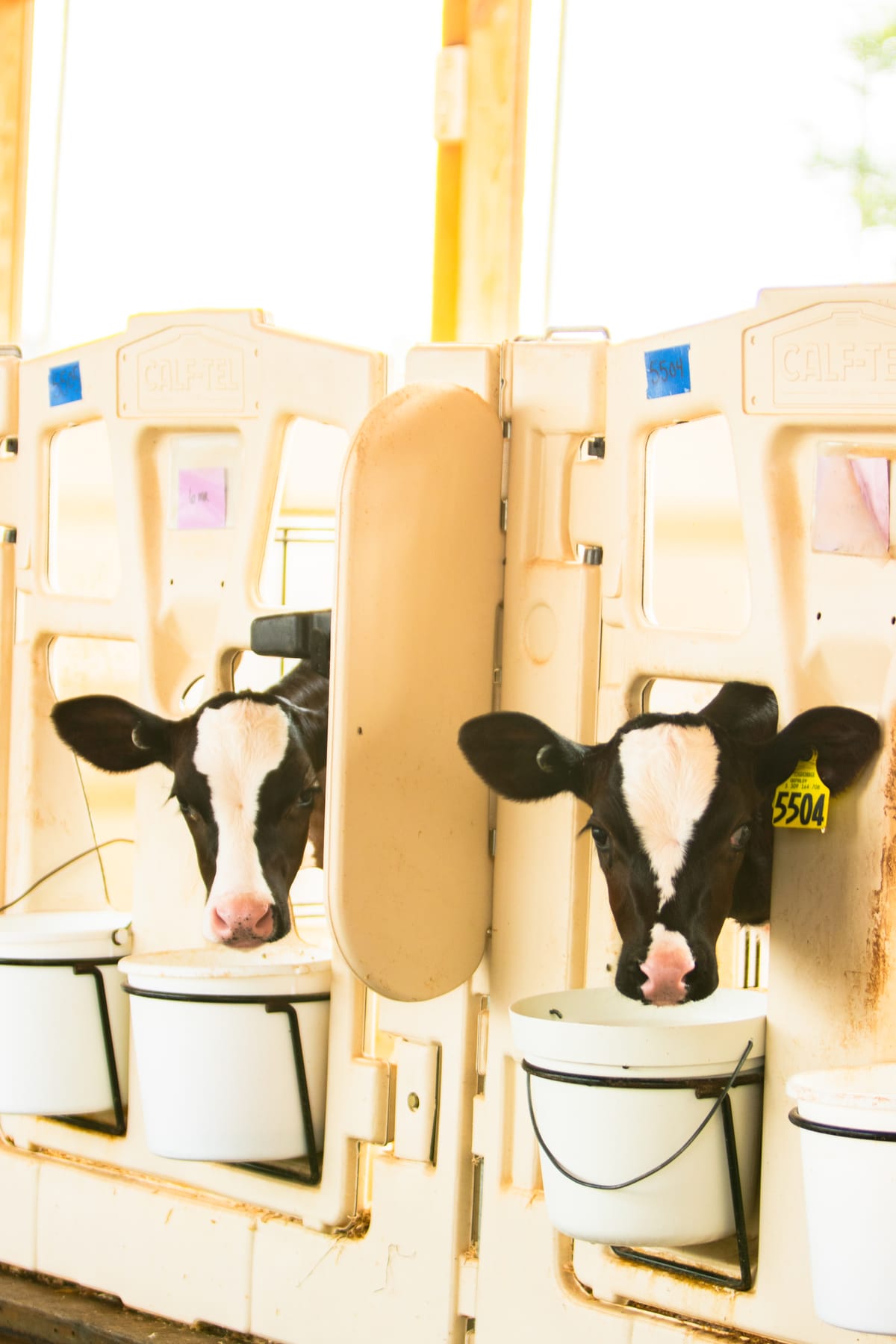
Very young calves may not show interest right away, but offering water is not a waste of effort. It helps calves acclimate to having a pail of water available, and they’ll eventually check it out — just like they’ll nibble on starter, or like you might reach for water after a few really salty fries.
Fill ’Er Up: Tips for Keeping Calves Drinking
Ensure fresh, clean, free-choice water is available to calves beginning by three days of age. Water should be easily accessible, replenished as needed, and buckets should be changed and cleaned daily. Wondering if the water is clean? Ask yourself if you’d drink it.
✓ Milk residue in milk buckets reused for water can encourage bacterial growth, attract flies, and deter calves from drinking. Rinse buckets before filling them with water to reduce contamination.
✓ Check automatic waterers daily for cleanliness and proper filling.
✓ Support calves through diarrhea with electrolytes between milk feedings. Denkacare Vitalrecover electrolytes provide a B-vitamin complex, electrolytes, and easily absorbable carbohydrates to replenish fluid losses and support recovery from scours.
✓ Submit a water quality sample for testing at least twice yearly. Poor water quality can negatively influence drinking behavior, nutrient absorption, and milk replacer mixing.
~Written by Poulin Grain Calf & Heifer Welfare Specialist, Cari Reynolds
Reference(s): Wickramasinghe, H. K. J. P., et al. 2019. Effect of free water access on growth performance, rumen development, and health of dairy calves.